
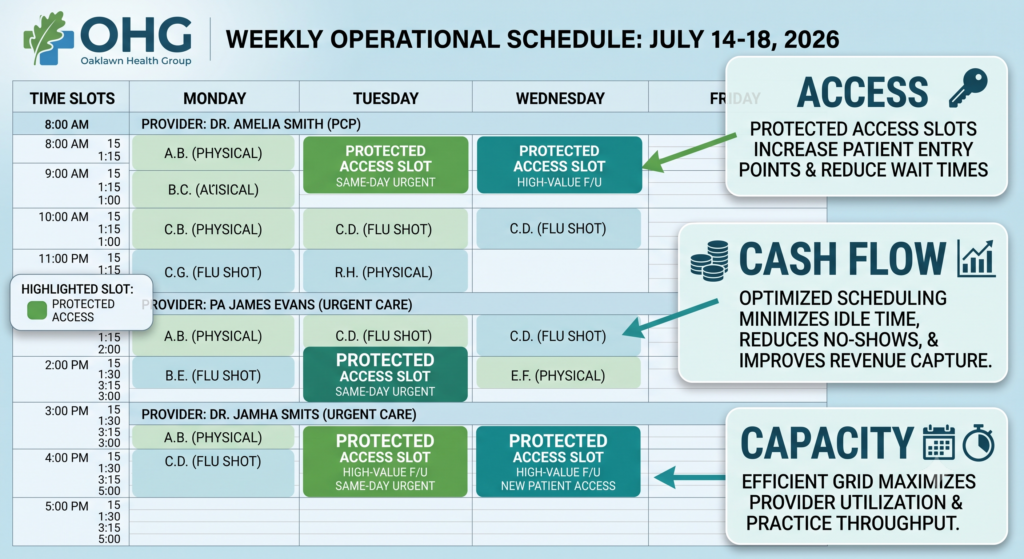
August is a good time for independent practices to look at the schedule before the fall rush starts.
Most practices review collections, payroll, and provider productivity. Fewer review whether the appointment book is quietly creating margin loss. That is a mistake. The schedule determines access, patient experience, staffing pressure, provider utilization, referral leakage, and cash timing.
A full calendar is not always a healthy calendar. The better question is whether the right patients are getting into the right slots at the right time, with the right financial expectations set before the visit.
Start with no-shows, not new patients
No-shows are not just an operational nuisance. They are unused capacity with payroll already committed.
Before blaming patient behavior, review the basics:
- Which appointment types have the highest no-show rate?
- Which providers or locations have the most late cancellations?
- Are reminders going out at the right cadence?
- Are patients being asked to confirm, or merely being notified?
- Is the cancellation policy clear, realistic, and actually enforced?
One practical move: review the last 30 to 60 days of no-shows by visit type. If follow-ups, imaging reviews, procedures, or high-value visits are repeatedly missed, the practice may need different confirmation rules for different appointment types.
Protect the slots that drive the business
Every schedule has invisible priorities. If the practice does not define them, the front desk will define them in real time.
That usually means the path of least resistance wins: easy follow-ups, familiar patients, and whoever is nicest on the phone. Meanwhile, new patient access, procedures, surgical clearances, referral requests, or commercially favorable visits may get pushed out.
Practices should identify the appointment categories that deserve protected access. That does not mean ignoring patient needs. It means designing the template so business-critical work is not dependent on luck.
A simple rule works well: hold certain slots for the highest-priority visit types, then release unused capacity at a defined time. Do not leave this to daily improvisation.
Match staffing to schedule reality
If Monday morning requires three people at the front desk and Thursday afternoon requires one, the staffing plan should reflect that. Many practices staff to habit, not workload.
Look at call volume, check-in volume, check-out volume, prior authorization work, portal messages, and referral processing by day and time. If the practice is understaffed during peak access periods and overstaffed during slow blocks, it will feel busy and still underperform.
This is where fractional operational leadership can pay for itself quickly. The issue is often not whether the practice has good people. It is whether the work is sequenced, measured, and managed.
Clean up payer mix inside the template
Not every open slot carries the same economics. Practices do not need to make scheduling feel transactional, but they do need to understand payer and visit-type mix.
If a provider’s best procedure slots are routinely filled with low-complexity visits, the practice may be giving up margin without noticing. If new patient visits are delayed while low-value follow-ups fill the week, referral relationships can weaken.
The goal is not to cherry-pick patients. The goal is to build a sustainable schedule that lets the practice serve patients well and remain financially healthy.
Set financial expectations before the visit
Schedule cleanup should include revenue-cycle handoff. Eligibility, benefits, referral requirements, authorizations, balances, and expected patient responsibility should be addressed before the patient arrives whenever possible.
A visit that looks productive clinically can still become a collection problem if the financial work starts too late.
The operator’s checklist
Before September, review:
- No-show and cancellation rate by appointment type.
- Third-next-available appointment for new and established patients.
- Template rules for protected visit types.
- Payer and visit-type mix by provider.
- Front-desk staffing by peak workload, not tradition.
- Pre-visit eligibility, authorization, and balance workflows.
- Referral slots and leakage risks.
The schedule is not just an appointment tool. It is a financial control.
Oaklawn Health Group helps small and mid-sized medical practices tighten operations, improve profitability, and build practical systems for growth. If your schedule is full but cash, access, or staff morale still feel strained, we can help identify where capacity is being lost and what to fix first.