
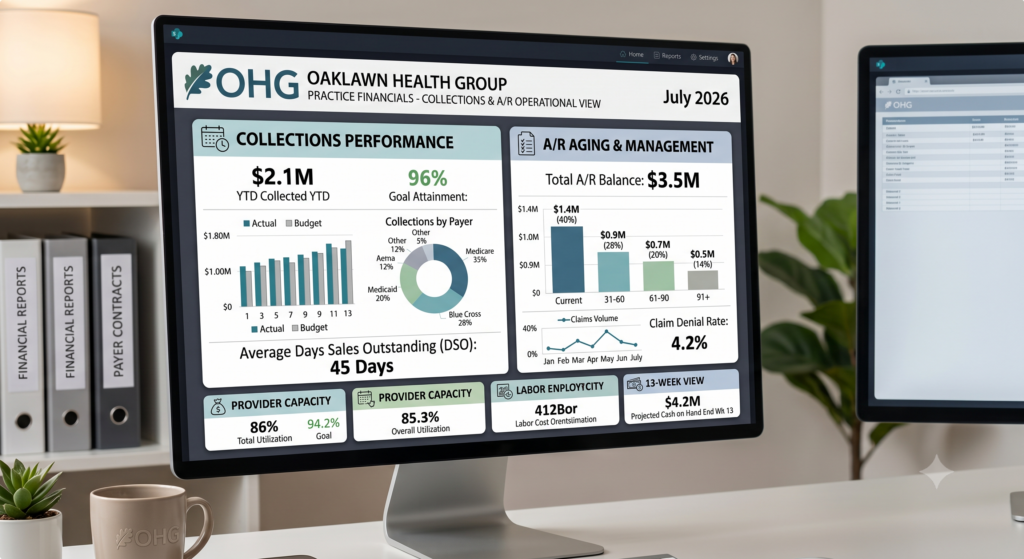
By July, most independent practices have a good sense of whether the year is tracking to plan.
The problem is that many practices wait until November to confront revenue cycle issues that have been sitting in plain sight since spring.
Mid-year is the right time to clean up collections because there is still enough runway to improve cash before year-end. This does not require a massive project. It requires looking at the right numbers, assigning ownership, and refusing to let old balances quietly become write-offs.
Here are five areas every independent practice should review now.
1. Days in A/R by Payer
A single days-in-A/R number can hide the real problem.
Break A/R out by payer and by aging bucket. If one commercial payer, Medicare Advantage plan, or managed care product is dragging the average, the fix is different than a broad billing-office issue.
Look closely at claims sitting over 45 days with no clear next action. Those claims need a reason code, owner, and follow-up date.
“Working A/R” is not a plan.
A practical review should answer three questions:
Which payers are slowing cash?
Which balances are aging without action?
Who owns the next step?
2. Denial Rate by Category
Do not stop at the total denial rate.
Separate preventable front-end denials from coding, authorization, credentialing, medical necessity, and timely filing issues. Each category points to a different operational fix.
If eligibility and authorization denials are rising, the answer is usually workflow discipline before the visit, not more billing staff after the visit.
If credentialing denials are appearing for a new provider or location, escalate immediately. Those delays can damage cash flow for months.
The best practices do not simply work denials. They prevent repeat denials from entering the system.
3. Net Collection Rate by Payer
Charges are not revenue.
Gross collection rate is usually noise. Net collection rate by payer gives a better view of whether the practice is collecting what it is contractually owed.
If a payer is consistently paying below expected allowed amounts, compare payments against the contract. Do not rely only on the fee schedule or average reimbursement.
Underpayments often look small one claim at a time. In the aggregate, they can become a meaningful margin problem.
A mid-year review should identify which payers are paying as expected, which are producing excessive denials, and which require escalation or contract review.
4. Patient Balance Conversion
Patient responsibility continues to matter.
Review how much patient A/R is collected at check-in, after EOB posting, after statements, and through payment plans. Many practices have policies on paper but inconsistent execution at the front desk.
Independent practices do not need to be aggressive, but they do need to be consistent.
Train the front desk on estimates, balance collection, payment plans, card-on-file rules where appropriate, and escalation. Inconsistent patient collections create staff conflict, patient confusion, and avoidable leakage.
The goal is not to surprise patients. The goal is to create a clear, predictable process.
5. Provider-Level Lag and Documentation Holds
If claims are delayed because notes are unsigned, charges are late, or coding questions sit unresolved, the issue is operational, not just billing.
Measure lag by provider and make it visible.
This does not need to be punitive. The goal is not to embarrass anyone. The goal is to protect the practice.
A physician-owned practice cannot afford to let preventable internal delays become a cash-flow problem. Provider documentation, coding response time, and charge lag should be part of the regular operating review.
If work is performed but claims are not going out cleanly and quickly, the practice is financing its own inefficiency.
A Practical 30-Day Cleanup Plan
A useful collections cleanup does not need to take six months.
Start with a focused 30-day plan.
Week 1: Pull A/R by payer, denial categories, net collection rate, patient A/R aging, and provider-level lag.
Week 2: Identify the top three cash leaks. Assign one owner per issue. Avoid shared accountability.
Week 3: Work the highest-value claims first, especially commercial balances over 45 days and denial categories with repeat causes.
Week 4: Review progress with providers and managers. Decide what needs a policy change, staffing change, payer escalation, workflow redesign, or outside support.
The key is to move from reporting to action.
A good mid-year review should produce a short list of problems, assigned owners, specific follow-up dates, and measurable improvement by the next month.
Bottom Line
Mid-year revenue cycle work is not glamorous.
It is one of the most reliable ways for a small to mid-sized practice to protect profitability without adding visits, extending hours, or chasing a new service line.
If cash feels tighter than it should, the issue may not be patient demand. It may be old A/R, preventable denials, payer underpayments, inconsistent patient collections, or internal documentation lag.
Those problems are fixable, but only if they are reviewed while there is still time to act.
Oaklawn Health Group helps independent medical practices assess revenue cycle performance, profitability, staffing, payer issues, and operational bottlenecks. If your practice needs a practical mid-year review, contact Oaklawn Health Group to discuss a focused practice assessment.
LinkedIn Companion Post:
By July, most independent practices know whether the year is tracking to plan.
The problem is that many wait until November to confront revenue cycle issues that were visible months earlier.
A practical mid-year collections cleanup should focus on five numbers:
• Days in A/R by payer
• Denial rate by category
• Net collection rate by payer
• Patient balance conversion
• Provider-level lag and documentation holds
The goal is not more reporting.
The goal is to identify old balances, repeat denials, payer underpayments, patient collection gaps, and internal delays while there is still time to improve cash before year-end.
Independent practices do not always need more volume to improve profitability.
Sometimes they need cleaner revenue cycle discipline.
Oaklawn Health Group works with small and mid-sized medical practices on profitability, revenue cycle performance, staffing, payer issues, operations, and practice assessments.