
Mid-year is a useful time to stop guessing.
Most small and mid-sized medical practices do not need a 40-page strategic plan halfway through the year. They need a clean view of whether the business is actually producing enough cash to support the decisions being discussed.
Should we hire another staff member? Replace a manager? Add another clinic day? Buy equipment? Adjust provider compensation? Consider a transaction?
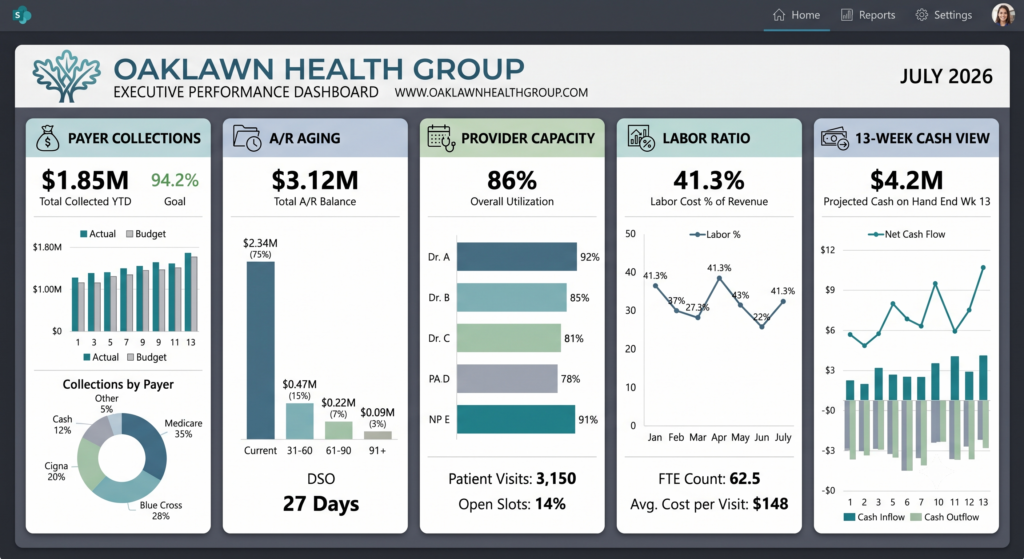
Before making those decisions, physician owners and administrators should review five numbers.
1. Net Collection Rate by Payer
Overall collections can hide a payer problem.
Start by reviewing payments, contractual adjustments, denials, and write-offs by payer for the last six months. A practice may look stable in the aggregate while one commercial contract, Medicare Advantage plan, or managed care product is quietly dragging down performance.
If one payer is underperforming, do not treat it only as a billing-department issue. First determine whether the issue is the fee schedule, authorization requirements, denial pattern, documentation workflow, posting logic, or underpayment tracking.
Managed care work starts with facts, not frustration.
2. Days in A/R by Age Bucket
Accounts receivable over 90 days is not just an accounting metric. It represents delayed payroll, delayed owner distributions, delayed vendor payments, and delayed reinvestment into the practice.
Review A/R by age bucket:
0–30 days
31–60 days
61–90 days
Over 90 days
Then separate insurance balances from patient balances.
That distinction matters. The fix for a payer follow-up backlog is different from the fix for weak front-desk collections or an unclear patient balance process. Lumping all A/R together makes it harder to know where the practice is actually leaking cash.
3. Provider Capacity Actually Filled
Provider productivity should not be evaluated by revenue alone.
Review available clinical hours, booked hours, arrived visits, no-shows, cancellations, and new-patient lag. A physician who looks flat on production may have a scheduling template issue. An APP who looks busy may be filling lower-margin visits while higher-value access is constrained.
Capacity should be measured before compensation, staffing, or provider effort gets blamed.
The right question is not only, “How much did this provider produce?” It is also, “Was the practice using the provider’s available capacity in the right way?”
4. Labor Cost as a Percentage of Collected Revenue
Payroll dollars matter, but payroll ratio matters more.
If labor expense is rising faster than collections, leadership should understand why before hiring, cutting, or restructuring. The issue may be volume weakness, overtime, poor role design, duplicated work, excessive call burden, turnover, weak manager accountability, or revenue cycle delays.
Cutting headcount without fixing workflow often creates a second problem.
A better mid-year review asks: Are staffing levels aligned with current volume, collections, provider capacity, and the actual work required to run the practice?
5. Cash Runway After Normal Owner Pay
Cash flow should be reviewed after ordinary physician compensation, not before it.
A practice can show profit on paper and still feel tight if collections timing, owner distributions, debt service, payroll, vendor spend, and A/R lag are not being managed together.
At mid-year, build a simple 13-week cash view. Include payroll, rent, debt payments, malpractice, major vendors, expected payer receipts, tax obligations, equipment purchases, and planned owner distributions.
This does not need to be complicated. It needs to be honest.
A 13-week cash view often gives leadership enough information to make better decisions quickly.
What to Do With the Findings
Once the numbers are clean, sort the issues into three categories.
Immediate cash protection: denial cleanup, aged A/R, patient collections, overtime control, and underpayment review.
Operating discipline: scheduling templates, role clarity, manager accountability, staffing structure, and vendor review.
Strategic decisions: provider compensation, new service lines, expansion, recruitment, valuation preparation, or buy/sell planning.
The goal is not to create more reporting. The goal is to stop making permanent decisions with incomplete information.
Bottom Line
Independent practices should not wait until year-end to find out whether the business is healthy.
Mid-year is the right time to review collections, A/R, provider capacity, staffing costs, and cash runway. Those five numbers can help owners avoid overreacting, underreacting, or making expensive decisions based on anecdotes.
A focused mid-year profitability reset gives the practice a clearer answer to a simple question:
Are we making decisions from facts, or are we still guessing?
Oaklawn Health Group helps independent medical practices evaluate profitability, revenue cycle performance, operations, compensation planning, start-ups, valuations, and buy/sell decisions. If your practice needs a clear mid-year financial and operational assessment, start with a focused review before making the next major move.
LinkedIn Companion Post:
Mid-year is the right time for independent medical practices to stop debating by anecdote.
Before hiring, cutting, expanding, or changing provider compensation, review five numbers:
• Net collection rate by payer
• A/R aging by insurance vs. patient balances
• Provider capacity actually filled
• Labor cost as a percentage of collected revenue
• Cash runway after normal owner pay
Most practice decisions get better when the facts are separated from the noise.
A focused mid-year review can protect cash, expose revenue cycle leakage, and prevent overcorrecting on staffing.
Oaklawn Health Group works with small and mid-sized medical practices on profitability, operations, revenue cycle, compensation planning, start-ups, valuations, and transactions.